1 / 1

These advantages contribute to the overall efficiency, quality, and performance of hot stamped structural components.
Hot stamping is a forming process that is performed after preheating the steel sheet, while cold stamping refers to the direct stamping of the steel sheet without preheating.
Cold stamping has clear advantages over hot stamping. However, it also exhibits some disadvantages. Due to the higher stresses induced by the cold stamping process compared to hot stamping, cold-stamped products are more susceptible to cracking and splitting. Therefore, precise stamping equipment is required for cold stamping.
Hot stamping involves heating the steel sheet to high temperatures before stamping and simultaneously quenching in the die. This leads to a complete transformation of the steel's microstructure into martensite, resulting in high strength ranging from 1500 to 2000 MPa. Consequently, hot-stamped products exhibit higher strength compared to cold-stamped counterparts.
Hot stamping, also known as "press hardening," involves heating a high-strength sheet with an initial strength of 500-600 MPa to temperatures between 880 and 950°C. The heated sheet is then quickly stamped and quenched in the die, achieving cooling rates of 20-300°C/s. The transformation of austenite into martensite during quenching significantly enhances the strength of the component, allowing the production of stamped parts with strengths of up to 1500 MPa.
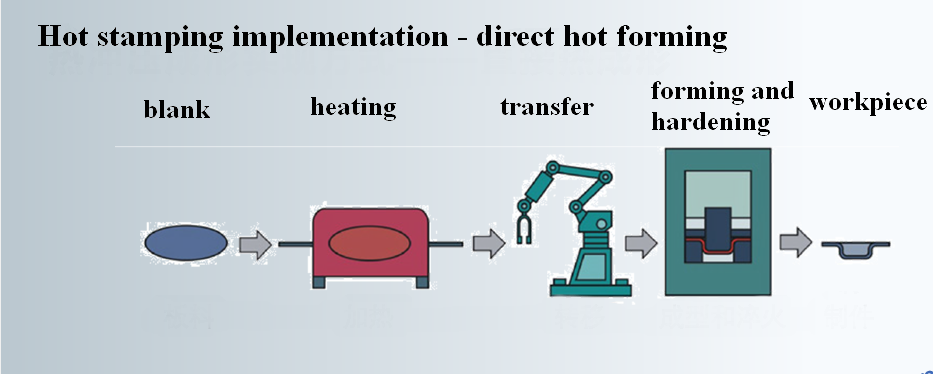
Hot stamping techniques can be classified into two categories: direct hot stamping and indirect hot stamping:
In direct hot stamping, the preheated blank is directly fed into a closed die for stamping and quenching. Subsequent processes include cooling, edge trimming and hole punching (or laser cutting), and surface cleaning.
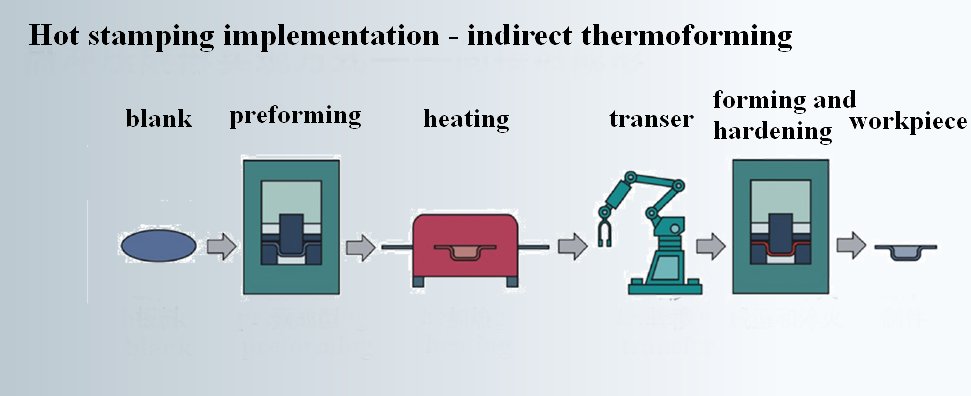
In the indirect hot stamping process, the cold forming pre-shaping step is performed before entering the stages of heating, hot stamping, edge trimming, hole punching, and surface cleaning.
The main difference between indirect hot stamping and direct hot stamping processes lies in the inclusion of the cold forming pre-shaping step before heating in the indirect method. In direct hot stamping, the sheet metal is directly fed into the heating furnace, while in indirect hot stamping, the cold-formed pre-shaped component is sent into the heating furnace.
Process Flow: Cold forming pre-shaping → Heating → Hot stamping → Edge trimming and hole punching → Surface cleaning
The production setup requires integrated units designed to handle extreme thermal transitions and high structural demands.
Equipped with heating and temperature control capabilities, the furnace heats high-strength plates to the recrystallization temperature within a specified time, achieving an austenitic state. It adapts to automated continuous production, requiring automated loading and unloading with high positioning accuracy. For non-coated steel plates, it provides gas protection to prevent surface oxidation and decarbonization.
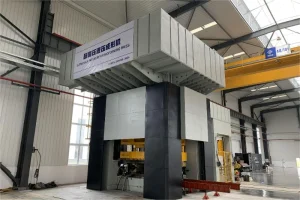
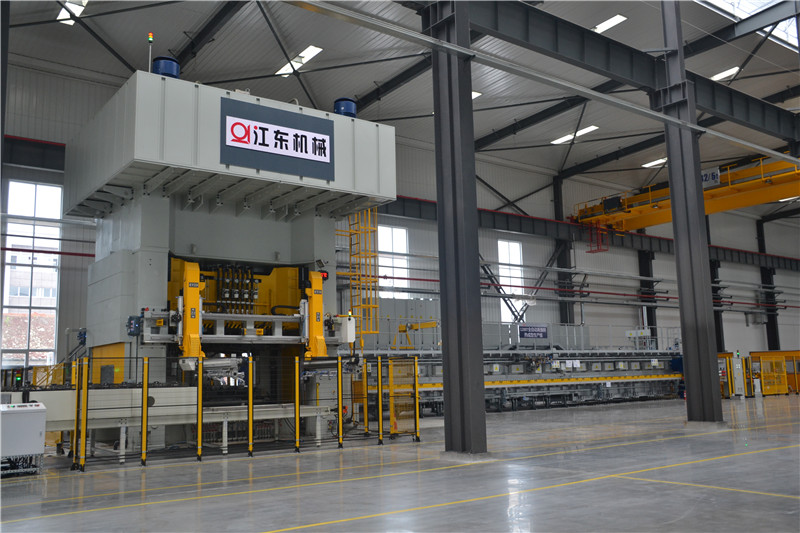
The press is the core of the hot stamping technology. It must provide fast stamping and holding pressure, and come equipped with a rapid cooling system. The technical complexity of hot forming presses far exceeds that of conventional cold stamping presses.
Hot stamping molds perform both forming and quenching stages. Once the billet is fed, the mold quickly completes the stamping process before the material undergoes the martensitic phase transformation. It then enters the quenching stage, where heat is transferred to cooling pipes built inside the mold. The role of pressure holding is to prevent uneven thermal expansion and contraction, which prevents warping and dimensional inaccuracy.
The quenching cooling speed affects both the cycle time and the conversion efficiency between austenite and martensite. The critical cooling temperature of boron steel is about 30℃/s; only when the cooling rate exceeds this threshold is the formation of a high-strength martensitic structure fully promoted. If the cooling rate is too low, non-martensitic structures such as bainite appear. However, an excessively high cooling rate can lead to cracking.
Due to the severe alternating thermal conditions (ranging from 200℃ to 950℃), hot stamping die materials require outstanding structural rigidity, thermal conductivity, and resistance to high-temperature abrasive wear.
Because the strength of the parts after hot stamping reaches about 1500MPa, traditional press cutting and punching would cause serious tool wear and require excessive tonnage. Therefore, laser cutting units are commonly used to cut edges and holes.
Currently, the common grade of hot stamping steel is B1500HS. The tensile strength before stamping is generally between 480-800MPa, and after stamping, the tensile strength can reach 1300-1700MPa.


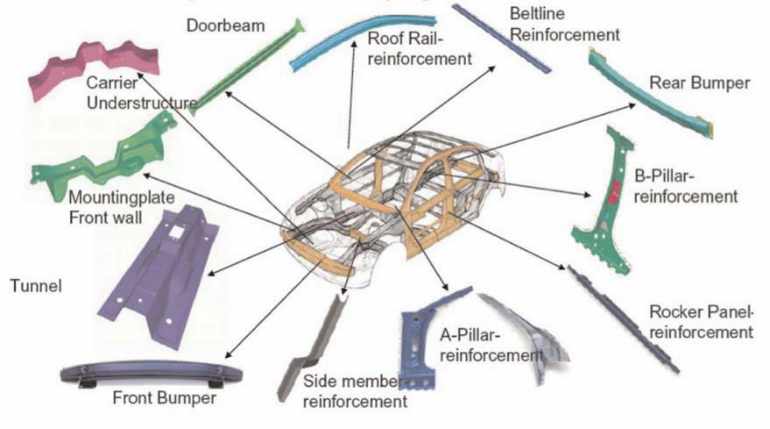
The application of hot-stamping parts can significantly improve collision safety and achieve lightweighting of the automobile body-in-white. At present, hot stamping technology is widely applied to parts such as A-pillars, B-pillars, bumpers, door beams, and roof rails.
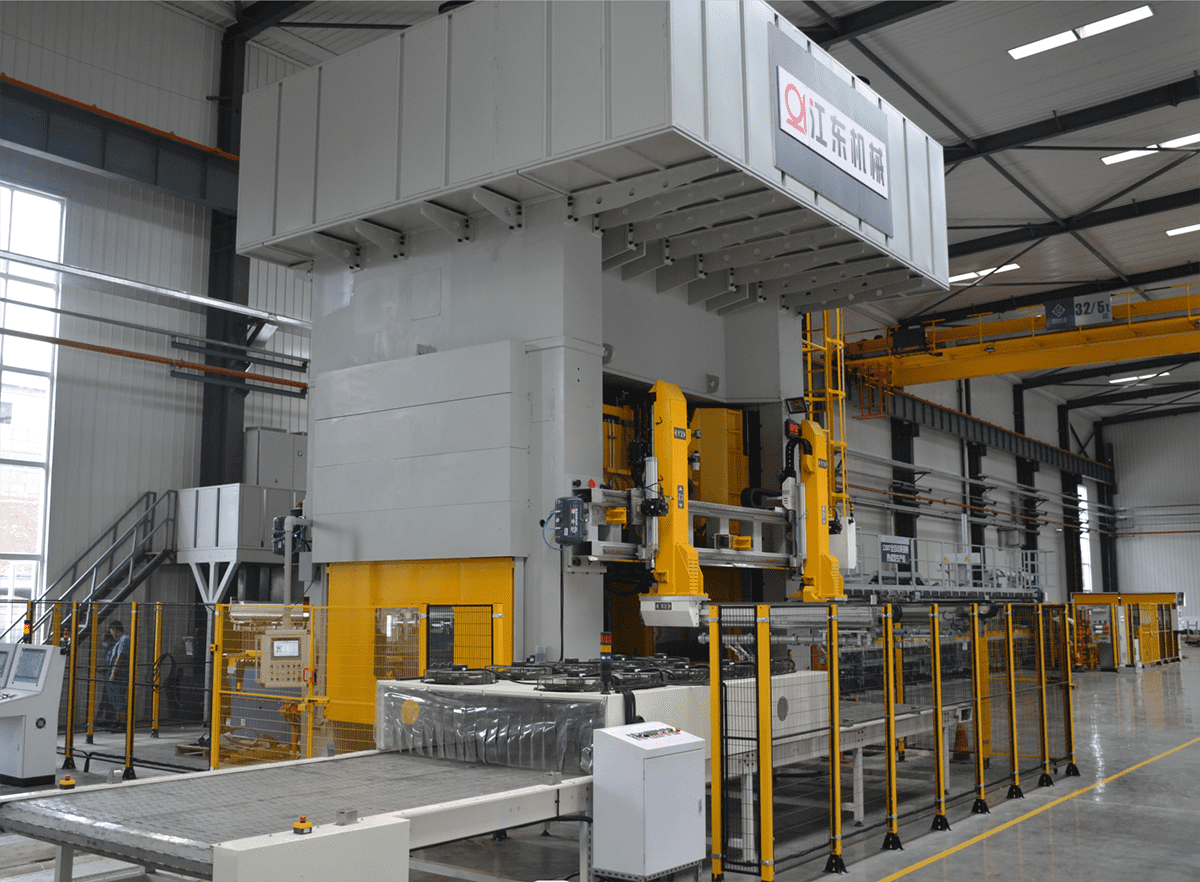
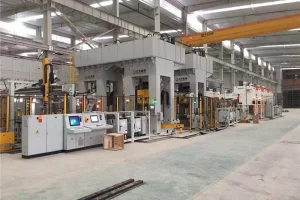
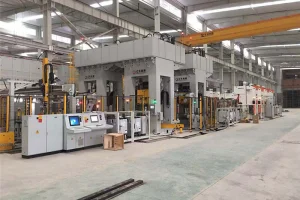
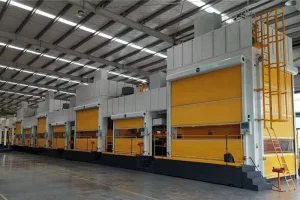
At present, hot stamping hydraulic press production line solutions have been very mature and stable, playing a huge role in promoting the development of the hot stamping industry. The production Line is designed to optimize the manufacturing process of automotive parts through the application of hot stamping technology. This process, known as hot stamping in Asia and press hardening in Europe, involves heating the blank material to a specific temperature and then pressing it in corresponding molds using hydraulic press technology while maintaining pressure to achieve the desired shape and undergo a phase transformation of the metal material.
The High-Strength Steel (Aluminum) High-Speed Hot Stamping Production Line finds wide application in the manufacturing of automotive white body parts. Additionally, the use of advanced alloys enabled by hot stamping is being increasingly explored in industries such as aerospace, defense, and emerging markets. These alloys offer the advantages of higher strength and reduced weight that are difficult to achieve through other forming methods.
Reduces the need for welding or fastening connection operations, resulting in improved efficiency and enhanced product integrity.
Minimizes undesirable deformations, ensuring precise dimensional accuracy and reducing the need for additional rework.
Hot-stamped parts exhibit fewer defects, such as cracks and splitting, compared to cold forming methods.
Reduces the required press tonnage compared to cold forming techniques, leading to cost savings.
Allows for the customization of material properties based on specific areas of the part, optimizing performance.
Eliminates or reduces intermediate manufacturing steps, resulting in shorter lead times.