
Rubber components are made in quiet, practical places: a heated mold closes, compound fills its cavity, and pressure shapes seals, bushings, or vibration mounts. A Rubber Compression Molding Press is central to this process. Its temperature control, platen alignment, pressure stability, and cycle repeatability can affect both part quality and production costs. Small variations matter. A seal may look sound yet fail dimensional checks.
Industry demand helps explain why press selection deserves careful attention. The International Rubber Study Group’s World Rubber Industry Outlook has tracked global natural and synthetic rubber demand at roughly 30 million tonnes annually in recent years. That scale spans automotive, industrial, construction, and consumer applications, each with different part tolerances and material needs. Market reports describe demand, but they do not prove that one machine suits every factory. That distinction is easy to overlook.
This Top 10 Rubber Compression Molding Press Manufacturers guide compares suppliers through practical considerations: press capacity, control systems, tooling support, service access, and experience with specific rubber compounds. Buyers should also examine quoted cycle times and sample-part evidence, not just brochure specifications. A fast press is not automatically the best press. Manufacturer claims need verification against real production conditions, especially when molds are large or changeovers frequent. The ranking is a starting point, not a substitute for testing parts, checking references, and confirming after-sales support.
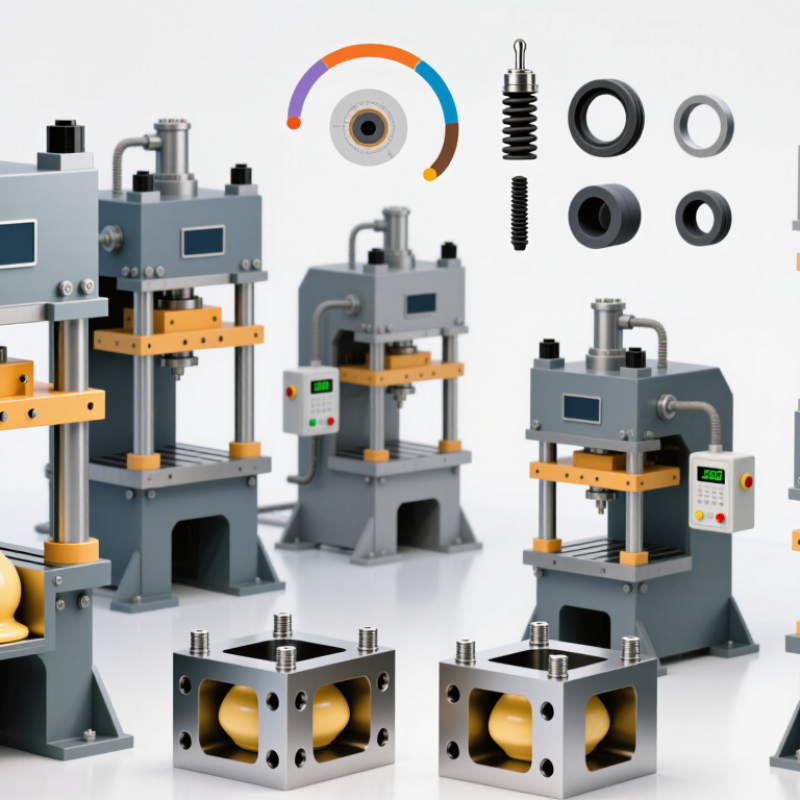
Rubber compression molding depends on heat, pressure, and time working together. A practical starting window is 150–200°C and 3–20 MPa, but compound chemistry and part thickness can shift the cure schedule. ASTM D5289 describes rotorless curemeter testing, which helps compounders measure scorch time and cure behavior before setting press cycles. The standard does not prescribe one universal press recipe. That distinction matters.
At 170°C, a thick rubber seal may still have a cooler center while its surface begins to cure. Pressure helps fill the cavity and reduce voids, yet excessive pressure can cause flash or distort a delicate insert. ASTM D3182 outlines controlled rubber mixing and preparation practices; consistent compound preparation supports repeatable molding results. Still, shop-floor conditions are rarely perfect. I would verify actual mold temperature and trial-part dimensions rather than trust platen readings alone.
Tips: Record cure time, mold temperature, and pressure for each trial. Check the part’s center, not just its surface. A small thermocouple can reveal a meaningful temperature lag.
This table provides general technical benchmarks for comparing press manufacturers; it does not rank or identify companies. Actual specifications depend on the rubber compound, mold design, projected mold area, and product requirements. The pressure range below refers to molding-cavity pressure, not hydraulic-system pressure.
| No. | Evaluation Dimension | Typical Benchmark or Calculation | Why It Matters |
|---|---|---|---|
| 1 | Curing temperature range | 150–200°C is a common process range; the compound supplier’s cure data should determine the actual setting. | Stable, controllable platen temperature supports consistent curing. The required temperature varies by compound and product. |
| 2 | Molding-cavity pressure | 3–20 MPa is a broad process reference range, not a universal setting. | The suitable pressure depends on compound flow, part geometry, mold venting, and the required fill quality. |
| 3 | Required clamping force | Approximate force = cavity pressure × total projected mold area. Example: 10 MPa × 0.10 m² = 1 MN, or about 102 metric ton-force, before engineering allowances. | Sizing the press from projected area helps prevent mold opening and flash; allow for the actual process and tool design. |
| 4 | Hydraulic pressure versus cavity pressure | These are different measurements. Hydraulic pressure acts in the press system; cavity pressure acts on the molded material and depends on press mechanics and mold area. | Comparisons are meaningful only when the stated pressure type and measurement method are clear. |
| 5 | Heating system and temperature control | Check the available heating method, control range, sensor arrangement, and temperature stability across the platen. | Even heat distribution helps reduce variation in cure state across a mold. |
| 6 | Platen size and mold coverage | Compare platen dimensions and usable area with the mold footprint, tie-bar spacing (if applicable), and loading clearance. | The mold must fit securely within the press working area and be accessible for loading and maintenance. |
| 7 | Daylight and opening stroke | Confirm the maximum open distance and stroke against the mold stack height, part removal method, and any loading equipment. | Adequate opening space supports safe mold access and efficient part handling. |
| 8 | Platen parallelism and force distribution | Review the manufacturer’s stated measurement method and tolerance; verify suitability for the mold size and required part uniformity. | Uneven platen loading can contribute to inconsistent thickness, flash, or uneven mold closure. |
| 9 | Venting and mold-breathing capability | Confirm whether the press supports the mold’s required venting sequence, such as controlled opening and repressing when specified by the process. | Appropriate venting can help release trapped air and reduce air-related molding defects. |
| 10 | Process monitoring and recipe control | Check for adjustable and recordable settings such as temperature, closing sequence, pressure or force, dwell time, and alarms. | Repeatable recipes and process records support production consistency and troubleshooting. |
Note: The ranges and calculations are general engineering references, not guaranteed specifications for any particular press or rubber compound. Confirm press sizing, cure conditions, and safety requirements with the press supplier, mold designer, and compound supplier.
Check platen size, daylight, stroke, temperature zones, and cycle repeatability. Fit matters.
It may increase equipment costs without improving part quality. Match capacity to the mold’s projected area and material.
Uneven heat can change cure times across a mold. Ask how temperature stability is checked under operating conditions.
Request capability data at operating conditions, not only peak ratings. Sample runs can reveal limits that brochures miss.
It classifies rubber materials by properties such as hardness, tensile strength, and resistance to heat or oil. It does not certify a press.
It addresses dimensional tolerances for molded rubber parts. A narrow seal groove may need tighter control than a broad pad.
Ask for inspection records and details about mold design, press settings, and measurement methods. Trial parts matter.
No. Uneven loading or inconsistent cure time can still affect quality. A polished certificate can be reassuring, but it is not the whole story.
This overview explains the fundamentals of rubber compression molding, in which rubber compounds are shaped and cured under controlled heat, typically around 150–200°C, and pressure of approximately 3–20 MPa. It outlines how manufacturers can be evaluated using practical criteria such as ISO 9001 quality management, available press tonnage, automation options, and after-sales service. The Rubber Compression Molding Press manufacturers are compared by machine capability, including presses ranging from 50 to 3,000 tons, platen dimensions, control systems, and energy efficiency.
The article also considers how equipment selection relates to production needs and finished-part requirements. Applications are discussed alongside relevant standards, including ASTM D2000 for rubber material classification and ISO 3302-1 for dimensional tolerances of molded rubber products. Together, these topics provide a framework for assessing press options and matching machine specifications with manufacturing processes, product designs, and quality expectations.