China’s vehicle industry is creating strong demand for faster, lighter, and more repeatable composite production. The China Association of Automobile Manufacturers reported approximately 30.09 million vehicle sales in 2023. New-energy vehicles represented about 9.50 million units. That scale matters. It turns manufacturing efficiency into a daily requirement, not a laboratory ambition.
Industry data supports the opportunity. MarketsandMarkets estimated the global composites market at about USD 126.3 billion in 2023. Its report projects growth to nearly USD 171.8 billion by 2028. HP-RTM Composite Molding Presses can support this expansion through short cycle times, controlled resin injection, and stable fiber compression. In a modern Chinese factory, the details are visible: heated tooling, automated preforms, pressure sensors, and a finished carbon-fiber panel leaving the cell within minutes. Small deviations still matter. A slight temperature imbalance can produce voids, uneven curing, or costly rework.
Professor Klaus Drechsler, a recognized composites manufacturing expert, has consistently emphasized a practical principle: composites succeed when design and production develop together. That view should guide any comparison of Chinese equipment. Maximum press force alone is not enough. Buyers should examine platen parallelism, injection synchronization, mold-temperature control, software traceability, maintenance response, and verified cycle data. Supplier brochures often look impressive. Factory evidence is more convincing. This guide evaluates the best China HP-RTM Composite Molding Presses through that practical lens, while acknowledging an uncomfortable point: public performance data is not always comparable. Real qualification trials, sample parts, and long-term service records remain essential.
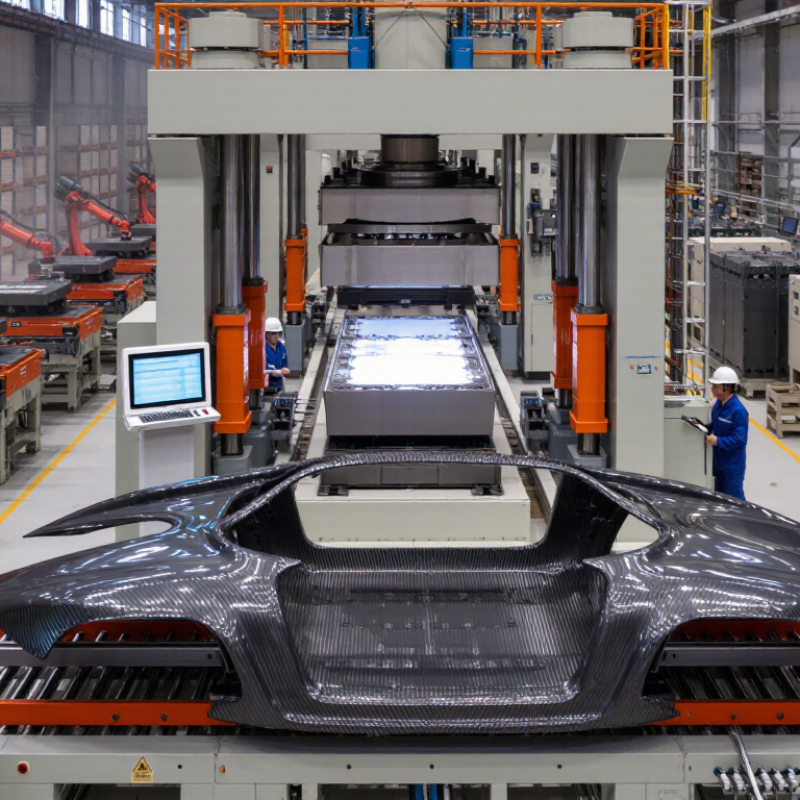
HP-RTM Fundamentals: 80–150 bar Injection Pressure and 5–10 Minute Cycles
The best China HP-RTM composite molding presses should support stable injection pressure between 80 and 150 bar. This range helps resin move through dense carbon or glass fiber preforms. Pressure alone does not define a reliable machine.
A practical press needs accurate mold closing, strong platen stiffness, and responsive hydraulic control. Uneven force can create resin-rich edges or dry areas near ribs. During trials, engineers should check pressure curves, mold temperature, vacuum stability, and part thickness.
A five to ten minute cycle is realistic for many automotive and industrial components, but it depends on resin chemistry, preform permeability, and mold heating. The clock is not always honest.
The injection unit should deliver repeatable shot volume with minimal air entrainment. A heated mold often operates around the resin supplier’s recommended processing temperature, while sensors record every cycle. I would also inspect platen parallelism with test tooling, not only trust a specification sheet. Small deviations may remain invisible on a flat panel, then appear around deep corners.
Maintenance access matters too; clogged lines and worn seals can quietly extend cycle time. A capable supplier should provide process data, sample parts, training, and traceable acceptance tests. Even experienced teams can underestimate cleaning time. That mistake deserves attention before comparing purchase prices.
Key Press Specifications: 1,000–3,600-Ton Clamping Force for Composite Molds
Selecting the best China HP RTM composite molding press starts with clamping force.
The practical range is 1,000–3,600 tons, equal to roughly 9.8–35.3 MN. This capacity suits medium and large composite molds, including structural automotive components. However, tonnage alone is a tempting shortcut.
Engineers should calculate projected mold area, resin pressure, mold stiffness, and the required safety margin. A 1,000-ton press may perform well with a compact mold, while a larger tool may require 3,600 tons for stable sealing.
Check this twice. Platen parallelism, closing speed, temperature uniformity, and injection synchronization also affect part quality. Useful controls should record pressure, displacement, resin temperature, and cure timing for every cycle.
MarketsandMarkets estimates that the global composites market could grow from about USD 111.6 billion in 2023 to USD 171.7 billion by 2028. The IEA’s Global EV Outlook 2024 also reported that electric car sales were expected to exceed 17 million units in 2024. These trends increase demand for repeatable, high-throughput RTM production. For Chinese equipment, buyers should inspect hydraulic stability, mold-change access, service response, and data export functions. A practical weakness remains overlooked: many specifications describe maximum force, but not long-term accuracy under heat. That omission deserves careful questioning.
Material Performance: Over 50% Fiber Volume Fraction in Structural Parts
What Are the Best China HP RTM Composite Molding Presses?
Material performance often begins with fiber volume fraction. In structural parts, exceeding 50% can improve stiffness and reduce resin-rich zones. U.S. Department of Energy vehicle lightweighting studies frequently use 50–60% fiber volume fraction as a performance benchmark for carbon-fiber composites. This range is demanding. Dry preforms must remain stable while resin flows through narrow channels.
High-pressure resin transfer molding requires more than a large tonnage rating. A capable press should provide balanced clamping force, accurate platen parallelism, and controlled mold temperature. IACMI technical roadmaps identify process consistency as a major barrier to high-rate composite production. Small temperature variations can change resin viscosity. Then, a perfect-looking panel may contain hidden voids.
The practical target is clear: maintain over 50% fiber volume fraction without sacrificing impregnation quality. JEC Observer reports continue to highlight automotive demand for faster composite cycles and repeatable structural performance. That pressure is reshaping press evaluation. Buyers should examine pressure stability, injection synchronization, vacuum integration, and recorded process data. A 2024 CompositesWorld industry review also emphasizes automation and quality monitoring for scalable RTM manufacturing.
One detail is often underestimated. Higher fiber content does not guarantee a stronger part. Poor wet-out can erase the expected benefit. Experienced teams should validate fiber fraction through burn-off testing, microscopy, and ultrasonic inspection. The process still needs refinement.
What Are the Best China HP RTM Composite Molding Presses? - Material Performance: Over 50% Fiber Volume Fraction in Structural Parts
How China’s HP-RTM Presses Compare on Precision, Automation, and Energy Use
When comparing China-made HP-RTM presses, precision appears in repeatable results, not brochure tolerances. A practical shop-floor test tracks mold alignment, injection pressure, temperature, and cycle time across 100 parts. Well-built systems can maintain stable platen movement and synchronized resin dosing. Small errors still matter. A 0.2 mm mismatch may cause flash, fiber movement, or uneven thickness. Technicians should compare pressure logs with finished parts, because software screens can hide mechanical drift. Closed-loop control can improve consistency when recipes change. However, sensor calibration is often overlooked during busy production weeks. It deserves a documented check.
Automation ranges from assisted loading to integrated robots, vacuum monitoring, resin mixing, and mold handling. The right level depends on workforce skills and product variation. A highly automated cell may reduce handling damage, but it can create difficult faults. Operators need clear alarms and practical recovery steps. Energy performance should be measured per acceptable part, not by press rating. Servo-driven hydraulics, insulated heating circuits, and shorter idle periods can reduce consumption. Actual savings depend on mold mass, cure temperature, and factory utilities. A press that heats quickly may use more power during repeated peak cycles. That detail is easy to miss. During supplier audits, request logged energy data, calibration records, and sample parts from continuous runs. One short demonstration is not enough.
Selection Criteria: Mold Size, Pressure Control, Cycle Time, and CE Compliance
Choosing the best China-made HP RTM composite molding press starts with mold size, not maximum tonnage. A 1,200 mm mold needs usable platen clearance, edge space, and reliable parallelism. The 2024 JEC Observer identifies automotive and industrial applications as major composites growth areas, where repeatable dimensions matter more than impressive specifications. Ask for platen flatness data, daylight measurements, and a sample mold trial.
Pressure control must remain stable during resin injection and curing. A closed-loop hydraulic system should record pressure, position, and temperature throughout each cycle. For many structural parts, a smooth pressure profile reduces fiber wash, voids, and uneven consolidation. Cycle time should include mold closing, vacuum stabilization, injection, cure, cooling, and demolding. MarketsandMarkets projected continued growth in the composites market through 2029, increasing pressure for shorter, measurable production cycles. Fast is not always productive.
CE compliance requires more than a printed logo. Request a technical file, risk assessment, declaration of conformity, safety-circuit validation, and operating instructions. The applicable Machinery Directive and relevant harmonized standards should be clearly identified. In my experience, suppliers sometimes quote curing time without counting cooling or manual handling. That estimate needs questioning. A factory acceptance test using your actual resin system and mold can expose this weakness before installation. Small details matter.
What Are the Best China HP-RTM Composite Molding Presses?
Selection should focus on mold capacity, stable pressure control, short and repeatable cycle times, and documented CE compliance. The chart shows representative engineering benchmarks for industrial HP-RTM press screening.
Typical screening benchmarks: mold working area around 1–4 m², pressure-control deviation of approximately ±1–3%, production cycles of about 8–20 minutes, and verified CE conformity for the complete machine and safety system.
FAQS
Exceeding 50% can improve stiffness and reduce resin-rich areas. Higher fiber content alone does not guarantee strength. Poor wet-out can cancel the benefit.
It should control clamping force, platen parallelism, mold temperature, and resin injection. Stable control supports consistent impregnation. Small variations matter.
Track alignment, injection pressure, temperature, and cycle time across 100 parts. A 0.2 mm mismatch may cause flash or uneven thickness. Brochure tolerances are not enough.
Uneven platens can shift fibers and create inconsistent part thickness. Finished panels may look acceptable while hiding defects. Measurement is necessary.
Useful features include assisted loading, vacuum monitoring, resin mixing, robots, and mold handling. The best setup depends on product variation and operator skills. More automation is not always better.
Measure energy per acceptable part, not only press power or tonnage. Insulated heating circuits and shorter idle periods can reduce consumption. Actual savings vary with mold mass and cure temperature.
Request pressure logs, temperature records, calibration documents, energy data, and continuous-run sample parts. One short demonstration is not enough. Ask for evidence.
Use burn-off testing, microscopy, and ultrasonic inspection. These checks can reveal poor wet-out and hidden voids. The process may still need refinement.
Do not judge a press by tonnage, speed, or software screens alone. Sensors may drift during busy production weeks. Calibration deserves a documented check.
Conclusion
Hp-Rtm Composite Molding Presses are designed for the high-pressure resin transfer molding of lightweight, high-strength composite components. Operating with injection pressures typically ranging from 80 to 150 bar, these systems can support production cycles of approximately 5 to 10 minutes when paired with suitable molds, resin systems, and process controls. Clamping forces from about 1,000 to 3,600 tons accommodate a broad range of structural parts, while carefully managed temperature, pressure, and resin flow help achieve fiber volume fractions above 50%.
When comparing China-made HP-RTM equipment, manufacturers should evaluate dimensional precision, automated control, energy efficiency, and long-term operating stability rather than focusing only on press tonnage. Important selection factors include mold size, pressure-control accuracy, cycle-time consistency, maintenance access, and CE compliance for applicable markets. A suitable press should also integrate reliable monitoring and safety functions, allowing manufacturers to balance productivity, part quality, energy consumption, and investment cost across different composite applications.