
2026 Top Titanium Aerospace Forming Press Manufacturers

Time:2026-10-09 Author:Aria
0%

The 2026 Top Titanium Aerospace Forming Press Manufacturers will be judged against a demanding production landscape. Boeing’s 2024 Commercial Market Outlook forecasts 43,975 new commercial aircraft through 2043. Airbus also expects more than 40,000 aircraft deliveries during the same period. These projections point to sustained demand for reliable titanium forming equipment, especially for landing gear parts, bulkheads, engine structures, and complex skin components.

Titanium is strong, light, and difficult to shape. It also punishes weak process control. A press may look impressive on a specification sheet, yet hydraulic stability, frame rigidity, temperature uniformity, and die alignment decide real production results. The U.S. Geological Survey’s Mineral Commodity Summaries 2025 identifies aerospace as a major application for titanium products. That fact matters when comparing manufacturers, because material availability alone cannot guarantee repeatable forming quality.

This guide evaluates leading suppliers through engineering capability, press capacity, automation, service response, and documented aerospace experience. It also considers AS9100 quality systems, NADCAP-related process expectations, installation support, and lifecycle costs. Some rankings remain debatable. Public data is uneven, and manufacturers do not always disclose cycle-time results or failure rates. That limitation deserves attention. Buyers should verify references, inspect test records, and request trials using comparable titanium grades and part geometries. A dependable Titanium Aerospace Forming Press is not merely a large machine. It is a controlled production system, standing beside operators through thousands of demanding cycles.
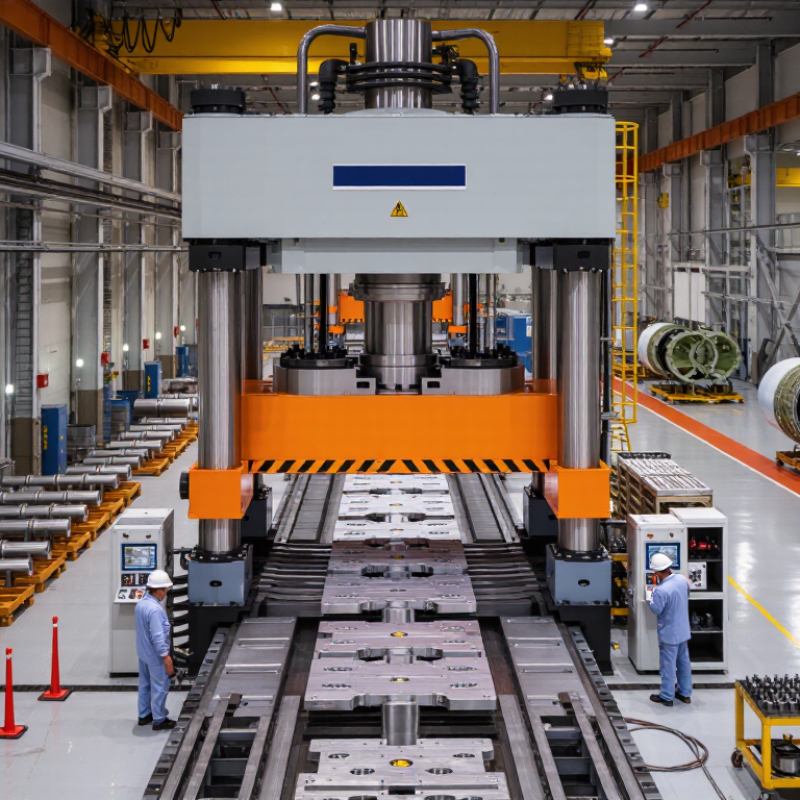
2026 Top Titanium Aerospace Forming Press Manufacturers

Titanium Aerospace Forming Presses: Definition and Core Functions

Titanium aerospace forming presses are industrial systems that shape titanium sheets, plates, or preforms under controlled heat and pressure. They support hot forming, superplastic forming, and near-net-shape forging. Unlike general metal presses, they must manage temperature uniformity, force accuracy, die alignment, and controlled cooling. Small deviations can create springback, uneven thickness, or hidden material stress.

Their core function is repeatable deformation. Hydraulic cylinders apply measured force, while heated platens or dies maintain the required forming window. Sensors record pressure, temperature, stroke, and dwell time for process verification. This data supports traceability, especially when manufacturers qualify structural parts under strict aerospace quality systems. The U.S. Geological Survey’s Mineral Commodity Summaries 2024 identifies aerospace as a major titanium-use sector, confirming the material’s continuing strategic importance. Boeing’s Commercial Market Outlook 2024–2043 also projects demand for 43,975 new commercial aircraft, indicating long-term pressure on advanced forming capacity.

Precision matters most.

A reliable press must protect the part, tooling, and operators during repeated cycles. However, higher tonnage does not automatically mean better forming. That assumption deserves testing. Thermal gradients, die wear, and imperfect loading can reduce accuracy even in a powerful machine. Industry teams should review calibration records, energy efficiency, cooling performance, and actual trial results before selecting equipment. The best evaluation is practical: inspect formed panels, compare thickness maps, and examine the process data rather than trusting specifications alone.

Key Technologies Used in Titanium Aerospace Forming Press Manufacturing

2026 Top Titanium Aerospace Forming Press Manufacturers

Key Technologies Used in Titanium Aerospace Forming Press Manufacturing

Titanium aerospace forming presses combine controlled heat, high force, and accurate timing. Hot forming systems often maintain temperatures above 700°C with narrow thermal variation. This matters because titanium reacts strongly to uneven heating. Hydraulic cylinders deliver stable pressure during complex part shaping. Servo-controlled systems can adjust speed during each forming stage.

Modern presses use vacuum or inert-gas chambers to reduce oxidation. Protective atmospheres help preserve the material surface and limit unwanted contamination. Embedded sensors monitor load, temperature, stroke, and tool alignment. Data logging supports repeatable production and stronger traceability. Some manufacturers now apply digital twins to predict springback and tooling stress. The results can be useful, but simulation still depends on reliable material data.

Tips: Check thermal uniformity before forming. Inspect dies for small surface damage. Calibrate sensors regularly. Keep forming records.

Experienced engineers also use closed-loop control to correct pressure changes immediately. Tool materials must resist heat, wear, and dimensional movement. Cooling channels can improve cycle consistency. However, cooling too quickly may create uneven stress. This remains an area needing careful review. Press design is advanced, yet operator judgment still matters. A small setup error can affect an expensive titanium component.

2026 Top Titanium Aerospace Forming Press Manufacturers - Key Technologies Used in Titanium Aerospace Forming Press Manufacturing
Capability Dimension Technology or Manufacturing Feature Typical Industrial Range or Requirement Technical Relevance to Titanium Aerospace Forming Common Quality or Process Reference
Press Architecture Hydraulic four-column, straight-side, or closed-frame forming press Approximately 10–80 MN for large aerospace components Provides high force, controlled dwell, and stable load distribution for titanium forgings, bulkheads, frames, and structural fittings. Press capacity is selected according to part envelope, projected area, material flow, tooling design, and required forming temperature.
Forming Process Hot forming, isothermal forging, warm forming, and creep forming Process temperature depends on alloy and forming method; titanium hot forming commonly uses several hundred degrees Celsius. Controlled-temperature forming reduces springback and forming load while improving dimensional repeatability for difficult titanium alloys. Exact temperature windows must be established through alloy-specific process qualification and furnace-to-tool studies.
Typical Titanium Alloys Commercially pure titanium and aerospace grades such as Ti-6Al-4V Grade-specific thermal and strain-rate limits Press systems must accommodate the high strength, low thermal conductivity, and narrow processing windows associated with aerospace titanium. Material certificates and heat-lot traceability are normally required for aerospace production.
Temperature Control Integrated furnace, heated tooling, thermocouples, infrared monitoring, and closed-loop control Multi-zone control with recorded part, die, and furnace temperatures Maintains uniform material flow and limits temperature loss during transfer from heating equipment to the forming zone. Temperature sensors should be calibrated and linked to the manufacturing data system.
Force and Position Control Servo-hydraulic control with programmable pressure, ram position, speed, and dwell Programmable multi-stage forming cycles Enables controlled strain rates, reduced cracking risk, repeatable die closure, and accurate control of final geometry. Force-position and time-temperature curves are commonly retained as process records.
Strain-Rate Management Low-speed forming, multi-step loading, and controlled ram velocity Application-specific; lower rates are commonly used for difficult hot-forming operations Helps prevent localized deformation, premature cracking, and non-uniform microstructural changes in titanium components. The qualified strain-rate window depends on alloy condition, temperature, geometry, and lubrication.
Tooling Technology Heated dies, low-friction die surfaces, replaceable inserts, and thermal-barrier systems Tool temperature and surface treatment are matched to the forming cycle Reduces heat loss, friction, galling, die wear, and material sticking during titanium forming. Tooling materials and coatings must be compatible with the selected temperature and production volume.
Hydraulic System High-pressure hydraulic power unit with proportional valves and accumulator support Pressure, flow, and cooling capacity sized for continuous duty Supports high forming force, smooth motion, rapid approach, controlled working speed, and stable dwell performance. Filtration, oil temperature control, leak prevention, and preventive maintenance are critical for repeatability.
Automation Robotic or mechanized loading, unloading, transfer, and die-change assistance Automated handling selected according to part mass, temperature, and takt time Shortens transfer time, improves operator safety, and reduces temperature variation between heating and forming. Automation may include interlocked guarding, presence detection, recipe management, and part identification.
Digital Monitoring PLC-based control, HMI recipe management, sensor logging, and production traceability Real-time logging of force, position, speed, temperature, and cycle time Creates a repeatable process record and supports statistical process control, troubleshooting, and audit readiness. Data integrity, access control, backup, and electronic record retention should be defined by the quality system.
Dimensional Accuracy Closed-loop ram positioning, die alignment monitoring, and post-form inspection Tolerance is part-specific and defined by the engineering drawing Controls thickness distribution, contour accuracy, flange position, and springback in near-net-shape titanium parts. CMM inspection, laser scanning, gauges, and first-article inspection may be used depending on part requirements.
Nondestructive Testing Ultrasonic, dye penetrant, radiographic, or eddy-current inspection Method selected according to geometry, defect type, and customer specification Detects internal discontinuities, surface cracks, laps, inclusions, and other defects that may affect aerospace service performance. Acceptance criteria are normally defined by the applicable drawing, specification, or approved customer quality standard.
Aerospace Quality System Documented quality management, process qualification, calibration, and traceability Typically aligned with AS9100-series aerospace quality requirements Provides structured control of design changes, supplier materials, nonconformities, corrective actions, and production records. Certification status must be verified for each individual manufacturer and production site.
Energy Efficiency Variable-speed pumps, regenerative hydraulic circuits, insulated furnaces, and heat recovery Efficiency depends on press size, duty cycle, furnace design, and automation level Reduces idle power consumption and thermal losses without compromising forming force or temperature stability. Energy performance should be evaluated using measured production-cycle data rather than press nameplate power alone.
Safety Engineering Guarding, two-hand controls, safety PLCs, light curtains, interlocks, and emergency-stop circuits Risk-assessed safeguards for high-force and high-temperature operations Protects personnel from crushing, ejection, hot tooling, hydraulic failure, and automated motion hazards. Applicable machinery safety requirements vary by installation location and regulatory jurisdiction.

Leading 2026 Manufacturers and Their Product Capabilities

Leading 2026 titanium aerospace forming press manufacturers are expanding beyond simple force ratings. Their strongest systems combine hydraulic control, programmable pressure curves, and accurate platen alignment. These features support demanding titanium sheet and structural component production.

Several leading manufacturers now offer hot forming presses with insulated chambers, controlled atmosphere systems, and temperature uniformity monitoring. Some machines reach forming temperatures above 900°C, depending on the alloy and process. Integrated sensors record pressure, temperature, stroke, and holding time. That data helps engineers trace defects before they become expensive failures.

Product capability also depends on practical factory details. Large bed sizes support wing fittings and frame sections, while compact presses suit brackets and prototype work. Automated loading reduces handling risks. Servo-controlled systems can improve repeatability and reduce energy waste during idle cycles. However, published specifications do not tell the whole story. A press may show impressive force, yet perform poorly with unstable temperature control. That matters.

Experienced manufacturers provide die trials, installation support, operator training, and preventive maintenance plans. Their engineering teams should understand springback, grain flow, lubrication, and titanium oxidation. I would still question any supplier promising flawless results without discussing material variation. Real production is less tidy. Dies wear. Sensors drift. Operators learn through small corrections. The best manufacturers leave room for inspection, process adjustment, and honest technical feedback. Fit matters more.

How to Evaluate Titanium Aerospace Forming Press Manufacturers

Evaluating a titanium aerospace forming press manufacturer requires more than comparing tonnage and purchase price. Check whether the press delivers stable force across the full stroke. Titanium forming often demands precise temperature control and slow, repeatable movement. Ask for measured data, not attractive claims. Review temperature uniformity, die alignment, hydraulic response, and vacuum or inert-gas performance. Small deviations can damage expensive aerospace material.

Request documented case studies involving titanium parts with similar thickness and geometry. Examine forming records, inspection reports, and nonconformance rates. A reliable manufacturer should explain how sensors detect pressure, temperature, and displacement changes. Traceable data matters during audits. Factory acceptance testing should use agreed criteria, sample dies, and recorded results. Operator training also deserves attention. A powerful machine is still risky when its interface confuses experienced technicians.

Service capability can separate a practical supplier from a disappointing one. Check spare-parts availability, remote diagnostics, response times, and local technical support. Visit the production site if possible. Look for clean assembly areas, calibrated instruments, and disciplined quality records. No manufacturer is perfect. I would question anyone promising zero maintenance or flawless delivery. A spreadsheet may hide installation delays, software limitations, or weak after-sales support. Ask difficult questions, contact previous customers, and compare answers against observed evidence. Reliability is built through details.

Industry Applications, Standards, and Future Development Trends

2026 Top Titanium Aerospace Forming Press Manufacturers

Titanium forming presses support aircraft frames, bulkheads, landing-gear parts, and engine structures. Hot forming Ti-6Al-4V often requires controlled heating near 900°C, accurate pressure, and slow tool movement. A small temperature drift can produce springback, cracking, or uneven grain flow. Operators still matter.

IATA’s 2024 industry forecast expects global passenger demand to double by 2043. This growth will increase demand for lighter airframes and repeatable titanium production. Press manufacturers must therefore offer larger working areas, stronger hydraulic systems, and automated loading. However, bigger machines are not always better. Energy use, maintenance access, and factory floor limits can decide the purchase.

Standards remain practical safeguards. AS9100 supports aerospace quality management, while AMS 2750 controls thermal processing and pyrometry. ASTM material standards help verify titanium plate, bar, and forgings. Reliable suppliers should provide calibrated sensors, traceable test records, and documented forming recipes. Digital twins and closed-loop force control are gaining attention, according to 2024 aerospace manufacturing technology reports. Yet their value depends on clean production data. That weakness is often ignored. Future presses may combine electric drives, predictive maintenance, and lower-carbon heating, but manufacturers still need skilled technicians and realistic validation trials.

Titanium Aerospace Forming Presses: Industry Applications and Process Windows

The chart presents representative hot-forming temperature windows commonly used for aerospace titanium alloys. Ti-6Al-4V remains the principal material for airframe parts, while higher-strength alloys such as Ti-6246 and Ti-5553 are used where improved elevated-temperature or structural performance is required. Production qualification typically considers ASTM B265 sheet and plate requirements, ASTM B348 bar and billet requirements, aerospace quality systems such as AS9100, and customer-specific forming, inspection, and traceability procedures. Actual press settings depend on part geometry, strain rate, lubrication, tooling, and furnace atmosphere.

FAQS

What features matter most in a titanium aerospace forming press?

Look for stable hydraulic control, programmable pressure curves, and accurate platen alignment. Force alone is not enough.

Why is temperature control important during titanium forming?

Titanium often needs controlled heat and slow movement. Uneven temperature can create defects, distortion, or inconsistent results.

What operating temperatures can these presses reach?

Some systems exceed 900°C, depending on the alloy and forming process. Confirm the actual range with measured records.

Which sensors should a forming press include?

Useful sensors track pressure, temperature, stroke, and holding time. Their records help engineers find defects earlier.

How should press size match production needs?

Large beds suit wing fittings and frame sections. Compact presses work better for brackets, samples, and prototype parts.

What evidence should a manufacturer provide?

Request similar titanium case studies, forming records, inspection reports, and nonconformance data. Attractive claims are not enough.

What should factory acceptance testing include?

Agree on test criteria, sample dies, and recorded results. Check force stability, die alignment, temperature uniformity, and movement speed.

How can buyers assess service and maintenance support?

Check spare-parts access, remote diagnostics, response times, training, and local technical support. Delays can become expensive.

What warning signs deserve extra attention?

Be cautious about promises of flawless results or zero maintenance. Sensors drift, dies wear, and operators still need adjustments.

Why should buyers visit the production site?

A visit may reveal clean assembly areas, calibrated instruments, and disciplined quality records. A spreadsheet can hide practical weaknesses.

Conclusion

Titanium Aerospace Forming Press systems are specialized machines designed to shape titanium alloys into precise, high-strength components for aircraft and space applications. Their core functions include hot forming, stretch forming, compression forming, and controlled heat treatment, while maintaining stable pressure, temperature, and dimensional accuracy. Modern manufacturing relies on advanced hydraulic or electric drive systems, programmable automation, real-time monitoring, precision tooling, and energy-efficient thermal control to support consistent production and reduce material waste.

In 2026, leading manufacturers are expected to distinguish themselves through large-capacity equipment, flexible forming solutions, intelligent process control, rapid tooling changes, and comprehensive after-sales support. Buyers should evaluate load capacity, working envelope, temperature uniformity, control accuracy, safety systems, maintenance requirements, certification, and total operating cost. Titanium Aerospace Forming Press equipment serves aircraft structures, engine components, landing systems, and space hardware, with production guided by strict quality and aerospace standards. Future development will focus on digital twins, predictive maintenance, lower energy consumption, automated inspection, and more sustainable manufacturing practices.

Aria

Aria

Aria is a dedicated marketing professional with a deep passion for innovative strategies and a keen understanding of our company's product offerings. With a wealth of experience in the industry, Aria excels at crafting engaging content that highlights the unique features and benefits of our......